Bone Fracture X-ray Scan Icons Set: Enhancing Medical Visual Communication
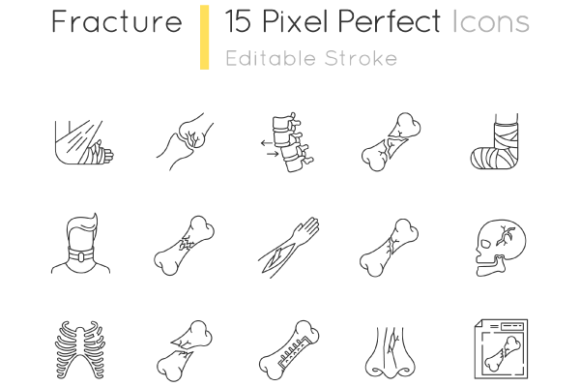
In the specialized field of medical design, clarity is not just an aesthetic preference; it is a functional necessity. Whether you are designing a patient education brochure, a mobile health application, or a clinical presentation, the visual representation of orthopedic conditions must be accurate, professional, and instantly recognizable. The Bone Fracture X-ray Scan Icons Set serves as a comprehensive visual toolkit designed specifically to bridge the gap between complex medical terminology and clear visual communication. This collection of pixel-perfect linear icons provides designers, healthcare professionals, and educators with the precise imagery needed to illustrate broken bone treatments, diagnostic procedures, and patient medical records without ambiguity.
Addressing the Challenges of Medical Visualization
Designing for healthcare presents unique challenges that generic icon libraries often fail to address. When illustrating concepts like bone fractures or X-ray diagnostics, standard stock graphics frequently lack anatomical accuracy or stylistic consistency. A common pain point for designers is finding icons that maintain legibility at small sizes while retaining enough detail to convey specific medical information. Furthermore, mixing icons from different sources often results in a disjointed user interface where stroke weights, corner radii, and visual metaphors clash, undermining the professional credibility of the final product.
The primary goal when selecting medical assets is to reduce cognitive load for the viewer. Patients reviewing their own medical records or treatment plans are often stressed or anxious. Unclear or cartoonish illustrations can trivialize serious conditions, while overly realistic imagery can be distressing. The Bone fracture X-ray scan pixel perfect linear icons set solves this by utilizing a thin line customizable illustration style. This contour symbol approach strikes an ideal balance: it is clinical enough to be taken seriously, yet abstract enough to remain approachable and non-threatening. By providing editable stroke vectors, this set allows creators to adapt the visual weight of the icons to match their specific brand guidelines or accessibility requirements, ensuring that the visuals support rather than distract from the medical content.
Practical Applications in Healthcare Design
The versatility of this icon set extends across multiple touchpoints in the healthcare ecosystem. Understanding how to implement these assets effectively can significantly improve user experience and information retention.
Patient Education and Brochures
One of the most critical applications is in printed and digital patient education materials. When explaining broken bone treatment protocols, text-heavy documents can overwhelm readers. Integrating isolated outline drawings of casts, splints, surgical screws, and healing stages helps break up dense information. For example, a post-operative care sheet becomes far more effective when accompanied by clear, linear icons indicating wound care steps, mobility restrictions, and follow-up appointment schedules. Because these icons are vector-based, they print crisply at any size, ensuring that brochures look professional whether viewed on a smartphone screen or printed on high-quality paper.
Digital Health Interfaces and Mobile Apps
For UX/UI designers working on telehealth platforms or symptom trackers, consistency is paramount. The Bone Fracture X-ray Scan Icons Set is engineered with pixel perfection, meaning every line aligns to the pixel grid to prevent blurring on digital displays. This is essential for mobile app screen pages where space is limited. Designers can utilize these contour symbols for navigation menus, category filters, or interactive body maps. The ability to customize the stroke width ensures that icons remain visible against various background colors and adhere to WCAG accessibility standards for contrast and clarity.
Clinical Documentation and Records
Beyond patient-facing materials, these icons serve a functional role in internal clinical systems. Electronic Health Records (EHR) and patient medical record interfaces benefit from standardized visual tagging. Instead of relying solely on text codes, medical staff can quickly identify fracture types, imaging modalities, or treatment statuses through universal visual cues. This reduces scanning time and minimizes the risk of misinterpretation during fast-paced clinical workflows. The clean, linear aesthetic ensures that these functional elements do not clutter the interface, maintaining a focused environment for data entry and review.
Technical Flexibility and File Formats
A significant advantage of this collection is its technical adaptability. Professional design work requires assets that fit seamlessly into existing workflows without requiring extensive cleanup or conversion. This set is available in multiple industry-standard formats, including JPEG, AI, PNG, EPS, and SVG. Each format serves a distinct purpose in the production pipeline:
- SVG (Scalable Vector Graphics): Ideal for web and app development, allowing for infinite scaling and CSS manipulation of stroke colors and widths directly in code.
- AI and EPS: Essential for print designers and branding specialists who need to modify anchor points, adjust proportions, or integrate icons into larger Adobe Illustrator compositions.
- PNG: Provides transparent backgrounds for quick placement in presentations, Word documents, or rapid prototyping tools like Figma and Sketch.
- JPEG: Useful for low-fidelity mockups or reference sheets where transparency is not required.
The inclusion of editable strokes is particularly valuable. Unlike flattened raster images, these vectors allow you to change a 2px line to a 1.5px line globally, ensuring that your bone fracture illustrations match the exact visual language of your project. This level of customization saves hours of redrawing time and guarantees a cohesive look across all deliverables.
Tailoring the Approach for Different Users
Different stakeholders interact with these assets in unique ways, and understanding these distinctions maximizes the value of the Bone Fracture X-ray Scan Icons Set.
Graphic Designers should focus on the grid alignment and negative space within the icons. When creating infographic elements, use the consistent spacing of this set to create rhythm and flow. The pixel-perfect construction means you can snap icons to your layout grid confidently, knowing edges will remain sharp.
Medical Professionals and Educators should prioritize semantic accuracy. While the icons are stylized, ensure you are selecting the correct representation for the specific fracture or treatment being discussed. Use the set to create visual glossaries that help patients understand their diagnosis. The neutral, linear style is particularly effective for diverse audiences as it avoids cultural or demographic specificity, making the medical information universally accessible.
Product Managers and Developers should leverage the SVG format for performance. Because these are optimized vector outlines rather than heavy raster images, they contribute to faster load times in mobile apps and web portals. Implement them as sprite sheets or inline SVGs to maintain high quality on retina displays while keeping asset bundles lightweight.
Streamlining Workflow with BSD Studio
Time is often the scarcest resource in design projects. Searching for disparate icons, fixing inconsistent styles, and redrawing assets to match a brand kit can consume days of billable hours. Count on us in search for icons, brochure templates, infographic elements, mobile app screen pages and so much more. BSD studio provides a variety of products, topics and file types so that there’s always something new to support your creative process.
By choosing a curated, cohesive collection like this, you are investing in efficiency without sacrificing quality. Find what you need in our shop to make sure you are saving time on design work while keeping up top quality. Whether you are updating a hospital’s wayfinding system, launching a new orthopedic telemedicine service, or refining a medical textbook, having a reliable, editable, and professionally crafted icon set ensures that your visual communication is as precise and effective as the medical care it represents.