Evaluating the Garbage Management App Page Bundle for Sustainable Tech Design
Developing digital solutions for waste management and recycling services requires a unique balance of technical functionality and user-friendly education. The Garbage Management App Page Bundle addresses this specific niche by providing a comprehensive set of mobile interface screens designed to streamline the onboarding process and visualize complex recycling workflows. For product designers, startup founders, and environmental agencies, this asset collection serves as a foundational toolkit rather than a finished product. It bridges the gap between abstract sustainability concepts and tangible user interactions, offering a structured approach to UI design in an industry that often struggles with digital engagement.
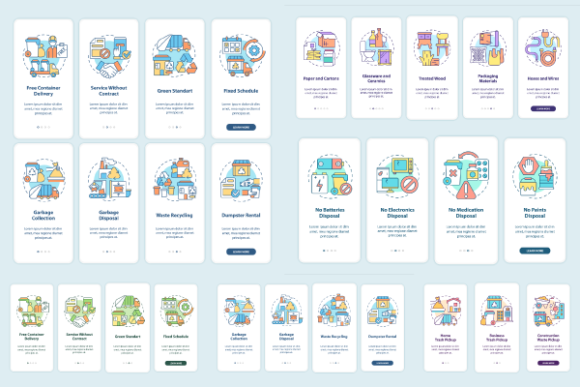
The primary value of this bundle lies in its specialized focus. Generic UI kits often lack the specific iconography and flow logic required for waste sorting, pickup scheduling, or educational walkthroughs. By centering the design around garbage management service onboarding, the bundle anticipates common friction points in green tech applications. It includes dedicated screens for a four-step recycling walkthrough, which is critical for apps aiming to change user behavior through visual instruction. This specificity reduces the cognitive load on designers who would otherwise need to research and illustrate these concepts from scratch, allowing teams to move faster from wireframing to high-fidelity prototyping.
Visual Style and Technical Versatility
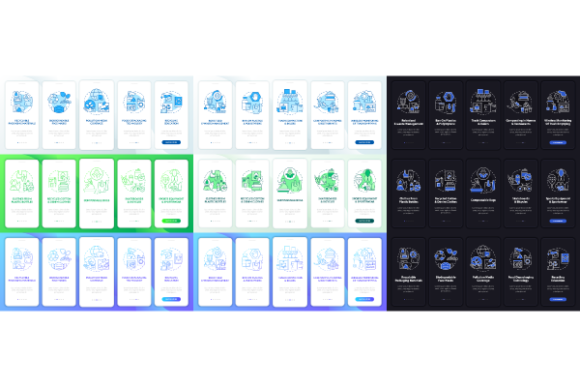
Aesthetically, the collection utilizes linear color illustrations, a style that has become standard in modern SaaS and utility app design. This vector-based approach ensures that graphics remain crisp across all device densities, from budget smartphones to high-resolution tablets. The linear style strikes a practical balance; it is friendly enough to encourage non-technical users to engage with recycling protocols, yet professional enough to maintain credibility for municipal or corporate service providers. The use of consistent stroke weights and color palettes across the bundle helps establish immediate visual hierarchy and brand coherence without requiring extensive manual cleanup.
From a production standpoint, the availability of multiple file formats significantly enhances the bundle's utility. The inclusion of AI, EPS, and SVG files caters to designers working within Adobe Illustrator or Figma workflows, allowing for deep customization of colors, shapes, and layout structures. Simultaneously, the provision of JPEG and PNG formats supports stakeholders who need quick previews for presentations, pitch decks, or marketing brochures without needing specialized design software. This multi-format delivery acknowledges the reality of cross-functional teams where developers, marketers, and designers must collaborate using different tools. The vector templates are particularly valuable for long-term projects, as they allow for easy updates if branding guidelines or regulatory recycling symbols change over time.
Analyzing the Four-Step Recycling Walkthrough
The standout feature of this package is the graphic instruction set for recycling. In waste management apps, user error is the primary operational cost; when users sort incorrectly, contamination rates rise, and processing efficiency drops. The four-step walkthrough included in this bundle is designed to mitigate this risk through progressive disclosure. Rather than overwhelming users with a dense text manual, the UI breaks down the sorting logic into digestible visual chunks. This aligns with established UX best practices for educational interfaces, where retention is significantly higher when information is paired with relevant imagery.
In real-world application, these screens can serve as the core of an interactive tutorial or a static help section. The linear illustrations provide clear conceptual representations of separation, cleaning, and categorization processes. However, designers should view these as a starting framework. Local recycling regulations vary drastically by municipality, meaning the generic concepts in the template will likely need adaptation. For instance, what constitutes "recyclable plastic" differs between regions. The strength of this bundle is that it provides the structural container for this education, but the content strategy must still be localized by the implementing team to ensure accuracy and compliance.
Practical Applications and Workflow Integration
The Garbage Management App Page Bundle is most effective when used to accelerate the discovery and validation phases of product development. For freelancers and agencies pitching to waste management clients, these screens provide immediate visual proof of concept. Instead of describing how an onboarding flow might look, designers can present polished mockups that demonstrate an understanding of the domain. This can shorten sales cycles and build client confidence early in the engagement. For internal product teams, the bundle acts as a low-cost alternative to hiring a dedicated illustrator for initial sprints, freeing up budget for user testing or backend development.
Beyond pure app design, the assets have secondary utility in marketing and educational collateral. The same linear illustrations used in the mobile interface can be repurposed for web landing pages, social media infographics, or printed community guides. This consistency across touchpoints reinforces brand recognition and creates a seamless omnichannel experience for users transitioning from physical flyers to digital tools. BSD studio’s inclusion of brochure templates and infographic elements suggests an awareness of this broader ecosystem, making the bundle a versatile resource for integrated campaigns rather than just a siloed UI kit.
Assessing Quality and Long-Term Value
When evaluating digital assets, consistency is often more important than individual screen quality. This bundle maintains a unified design language throughout the onboarding and instructional flows, which prevents the disjointed feel that often occurs when piecing together resources from multiple sources. The layers in the source files are generally organized logically, facilitating efficient editing. However, as with any pre-made asset, there is a risk of genericism. If multiple competitors in the same geographic market use this exact bundle without significant modification, apps may begin to look indistinguishable. To maximize long-term value, teams should treat these templates as a baseline, injecting custom photography, proprietary icons, or unique micro-interactions to differentiate their final product.
Reliability also extends to the scalability of the design system. The vector nature of the assets means they are future-proof against hardware changes. As foldable devices and new screen aspect ratios emerge, having source files that can be resized without degradation is a significant advantage over raster-only alternatives. The bundle’s focus on fundamental UX patterns—clear navigation, accessible contrast, and intuitive iconography—also suggests it will age better than trend-heavy designs that rely on fleeting visual fads.
Target Audience and Strategic Fit
This resource is specifically calibrated for professionals operating at the intersection of civic tech, sustainability, and mobile design. Small business owners launching local recycling startups will find it invaluable for creating a professional presence without enterprise-level design budgets. Educators and non-profit organizers developing community awareness apps can leverage the instructional graphics to communicate complex environmental concepts effectively. Freelance UI/UX designers specializing in gov-tech or smart city projects will appreciate the domain-specific shortcuts it offers.
However, the bundle may be less suitable for highly specialized industrial waste management platforms that require technical schematics or regulatory compliance dashboards beyond consumer-facing onboarding. It is primarily a B2C or B2G communication tool, not an enterprise resource planning interface. Additionally, teams with zero design capability may struggle to adapt the source files effectively; while the JPEGs are ready-to-use, the true value unlocks only for those comfortable editing vectors. Understanding this distinction is crucial for determining ROI.
Making the Decision
Ultimately, the Garbage Management App Page Bundle represents a pragmatic investment in design velocity and domain relevance. It solves the blank canvas problem for a niche vertical that demands both clarity and aesthetic appeal. By providing a cohesive set of onboarding screens and educational walkthroughs in editable vector formats, it empowers creators to build better waste management tools faster. Success with this asset depends on recognizing it as a flexible foundation rather than a rigid solution. When customized thoughtfully and integrated into a broader user research strategy, it serves as a reliable catalyst for building digital products that genuinely support sustainable behaviors. For teams seeking to save time on foundational design work while maintaining professional standards, this collection offers a balanced mix of utility, quality, and adaptability.